About Me
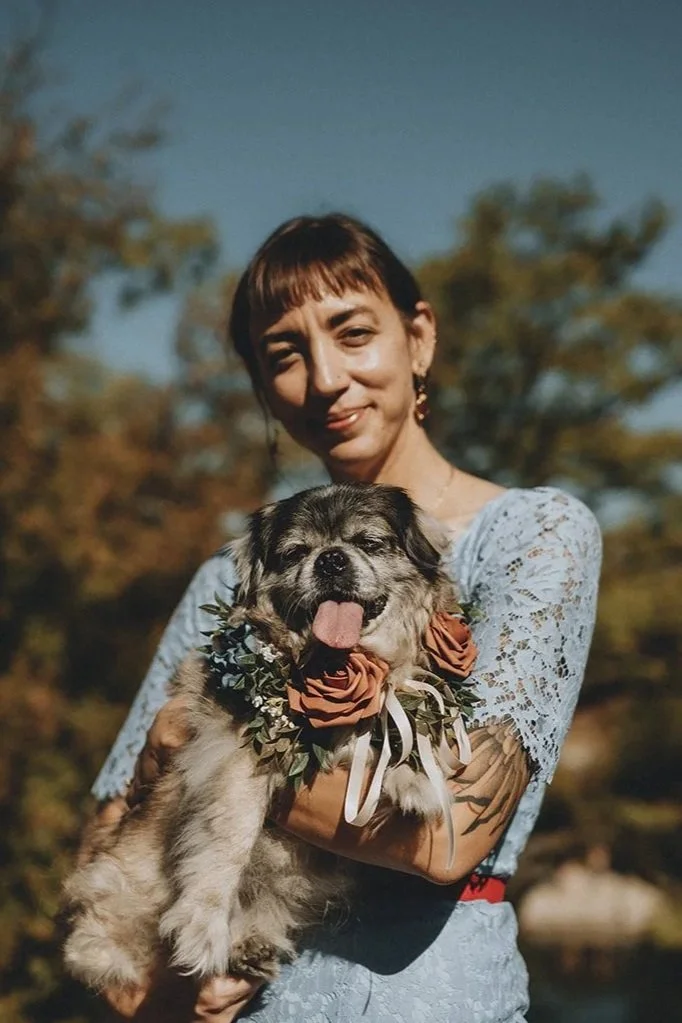
Hi, I’m Annie (Angela) Baucom (she/her), a Death Doula and Grief Guide living in Austin, TX. As an insatiably curious person who cares deeply for the well-being of those around me, I feel a calling to support others as we look into big and sometimes scary topics of life, mortality, and the unknown together.
I have been providing my community with companionship and grief support since 2019. I have specialized in providing socialization for people receiving hospice care and especially people with dementia. Since January 2020, I have also been facilitating free grief support services through Hospice Austin, including both in-person and online adult drop-in support groups, 8-week groups focused on intensive grief care through specific losses, and youth grief support through a summer experience at Camp Brave Heart. In partnership with Hospice Austin, I co-created the area’s first and only free LGBTQ+ grief support group providing peer support and a safe space where grievers can be their full authentic selves.
I hold a Master of Science in Social Work from the University of Texas at Austin and completed End-of-Life Doula training with the International End-of-Life Doula Association (INELDA). Along with my formal credentials, I bring decades of experience as a conscious fellow griever and more than seven years as a hospice volunteer in service to my neighbors.
I hope to serve adults of any stage of life in the Austin area who want to plan for or explore their curiosity about death and dying, or who are experiencing grief after a significant loss. I believe it’s never too early to build mortality-awareness to help you feel like you are living each day fully and without being driven by fear or incapacitated by grief. While I enjoy providing a range of services and support to people of any background, I truly thrive when I am able to serve my LGBTQIA2S+ community.
When I’m not working, I love reading sci-fi and fantasy books, giving treats to my backyard chicken flock, and spending quality time with my spouse, dog, and cat.
If you want to see if my services might be a good fit for you, please fill out my contact form. I would love to meet you!
My philosophy of care
Everyone providing personal death and grief care brings their unique human self and perspectives to their work. That means not every worker is right for every need. Each consultation is a chance for us to see if we can step into this work together safely, compassionately, and effectively to help you reach your next stage.
I hold each person’s self-determination to be the ideal goal and north star guiding my work. The power of choice and the capacity of each person to make and realize their choice drives my inquiry-based process as I help you unearth what is most true and important for you. Whether it’s giving yourself permission to die how you want to or grieve how you need to, I work to help you feel confident and clear about your path.
I hold each person I work with in unconditional positive regard, creating safe and judgment-free spaces for us to explore the muck and shadows of our lives right alongside the sometimes underappreciated mundane beauty. I maintain a commitment to confidentiality so that we can build trust as you confront topics that we have all been taught to avoid.
As a member of the LGBTQ+ community, I have seen firsthand and with many others how social stigma and complex relationships can impact the dying and grieving processes. My experiences have taught me how to cultivate spaces and relationships that provide safety and loving warmth.
As someone with a background in social work and experience with complicated (perhaps dysfunctional) family dynamics, I am ready to talk about how loved ones do and do not show up effectively in times of loss. Communicating with clarity, empathy, and understanding is always the goal, and I use coaching and mediation when necessary to support harm reduction when repair is out of reach.
Regardless of who I am walking alongside and where that path takes them, I am devoted to meeting them where they are. To me, this means being curious and matching your communication needs. I love indulging my polite southern side as much as my irreverent dark-humor-loving side according to the company I am enjoying. I encourage those around me to show up exactly as they are so I can rise to the connection.
My personal story of loss, healing, and answering the call
I often say that there are two primary channels to death and griefwork. The first is witnessing a powerfully beautiful death that inspires a person to bring an abundant sacredness and reverence to the bedside of every dying person and their loved ones. The second is being a part of one or more less-than-perfect dying experiences that makes a person question what it would actually look like to die well. For me, it was much more the latter than the former, at least in the beginning.
My mother Helen was diagnosed with breast cancer at the age of 45 when I was 14 years old. After four years of cycling treatment, remission, recurrence, and spread, she died at the young age of 49 and just a week shy of my high school graduation. I am forever grateful for the time I had with her and the way she and my father made every effort to ensure I was able to have some shred of normalcy in my teen years. Still, the ways in which mainstream American culture and my family of origin’s culture influenced how we experienced her end-of-life left me with a shocked feeling of being slammed into a wall. Almost without warning, I was drowning in pain and endless questions and, somehow, just expected to bear it and carry on.
Those final years and especially the final weeks and days of her life were marked for me by secrets. I knew my mother was receiving hospice care, but no one told me what that even meant. For too long, I just thought they rented out medical equipment that they would take back after someone died. Since I had been living a latchkey lifestyle while my parents shuffled back and forth from the hospital for several years, I didn’t understand there was anything unusual about the time leading up to her death. No one asked me to stay close to her in her final days and hours. No one told me how close her death might be. I wasn’t invited to her bedside for her last breath. I was only told when she was already gone and given no ideas about how to keep on living myself while carrying the heaviness of that sorrow.
In the more than 20 years since her death, I have worked to build my capacity to live beyond loss. In adulthood, I developed a deeper understanding of the ways in which people wanted to protect me (and themselves) from the harsh truth of illness and death that comes too soon and devastates bodies and spirits so completely. I have been able to see and appreciate the immense love that surrounded my family then and to this day. And I have been able to hold compassion for myself and my loved ones who were given the impossible task of trying to do what was best and right when, through no fault of anyone involved, there was never going to be a better outcome.
I have collected more losses over the years. Illness, overdose, suicide, none of them rational or just. Some sudden and some prolonged, human and animal companions, people I knew well and a few I knew mostly through others. I would even include non-death related losses that have each needed to be mourned in their own way as relationships, jobs, and dreams have reached their ends. Each has had important things to teach all of those left behind to carry on without them. With the experience and reflection I have accumulated over the last two decades, I have also developed ways to communicate what I have learned, alongside a capacity to sit with others in their deepest pain without looking away.
When I first learned what a death doula was around 2017, all of that learning and growing clicked. My mission now is to be the person for others that my family and I needed when we were all trying to navigate my mother’s illness and mortality. I hope that I can help other beautiful, beloved humans ask important questions and face death with more knowledge, courage, and someone to advocate for them when they not be able to advocate for themselves.
There are as many ways to die as there are people in this world. I will not project my experience onto another person or family. However, I will approach each person, family (of any definition), and system of loved ones with the same commitment to informed and empowered choice that I wish for that teenage girl who found herself so suddenly adrift. Your death and grief journeys can be your own. You can have agency in your path. I look forward to walking alongside you as you do.